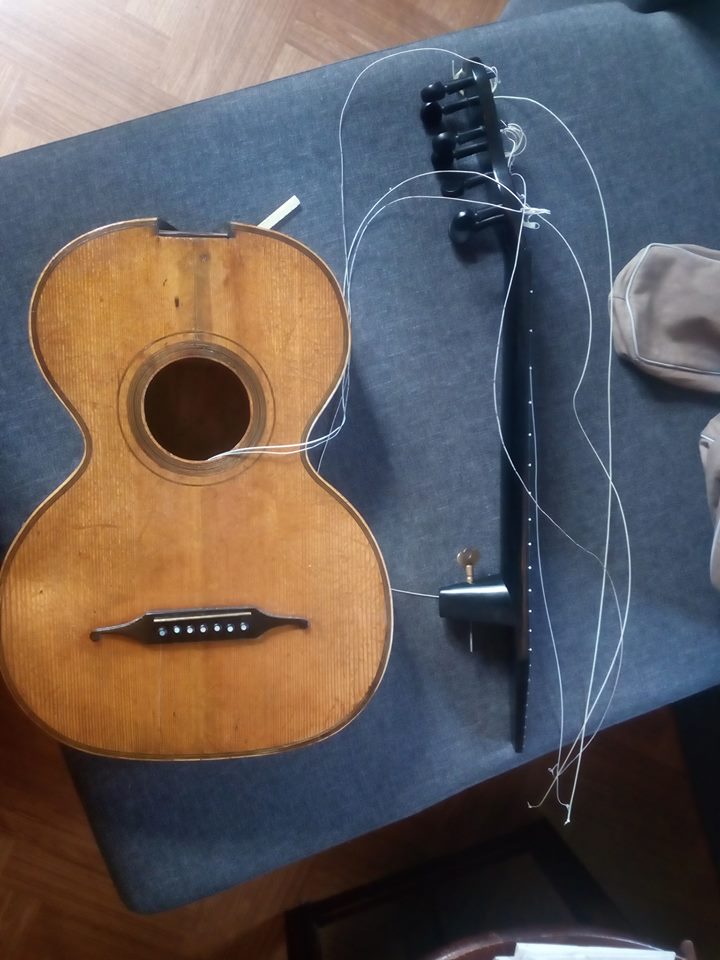

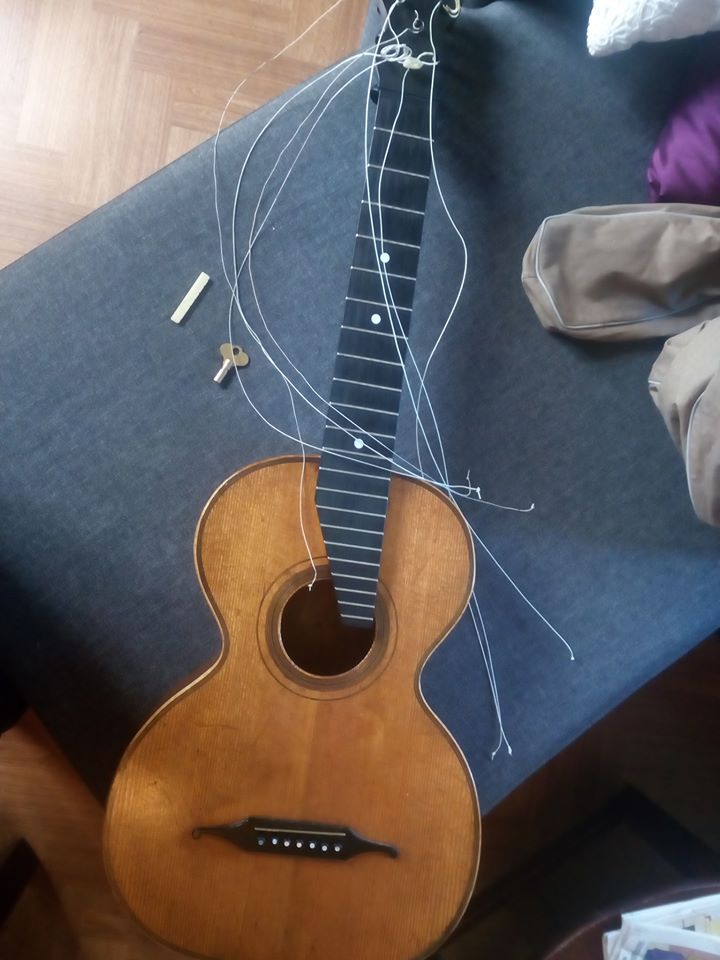
Historic detachable-neck guitar · Les Arques, Lot
The classical guitar, as we know it today, is a young instrument: a little more than a century and a half separates us from Antonio de Torres Jurado, the luthier from Almería who established it in its current form. And among the decisions taken during that process of consolidation, one of the most silent and far-reaching was the abandonment of the mobile neck.
What follows is the complete account of that history: an underground current that appears with vigour in nineteenth-century Vienna, is eclipsed during the century of Torres, Tárrega and Segovia, and resurfaces at the end of the twentieth century under an entirely different motivation — the problem of air travel — that no Romantic luthier could have imagined.
The problem of portability in plucked string instruments
Every plucked string instrument with a resonance box has, by its very nature, a long neck and a voluminous body. This geometry, optimal for sound production, is extremely poor for storage and transport. The Renaissance lute, the vihuela, the Baroque guitar and the Romantic guitar all faced the same practical dilemma: how to move the instrument from the musician's home to the palace, the inn or the theatre?
For centuries the answer was one: with a custom-made case, almost as bulky as the instrument itself. Throughout the pre-industrial period there existed no technical tradition oriented towards reducing the constructive size of the instrument itself. The reason is historical: the itinerant musician travelled by carriage, on horseback or by ship; the additional space of a case was marginal. Only in the twentieth century, with commercial aviation, did portability move from being a secondary virtue to becoming an autonomous technical problem.
It is worth distinguishing, from the outset, three historically distinct motivations that have led different builders to seek neck separability:
- Neck-angle adjustment — modifying the neck angle to set string action (Stauffer, 1820; Smallman, 20th c.).
- Ease of repair — bolt-on neck easily removable by a technician for a neck reset (Taylor Guitar Company, late 20th c.).
- Travel portability — the neck must be detachable by the musician in under a minute, without tools, and without needing to re-tune after reassembly.
This third motivation is the only one that has come to constitute a genuine sub-segment of the lutherie market, with dedicated brands, specific patents and a stable audience. Its history occupies most of what follows.
The Viennese school and the adjustable neck: Stauffer (1820–1860)
To understand the emergence of the adjustable neck it is essential to situate oneself in Vienna at the beginning of the nineteenth century. The Habsburg capital was, alongside Naples, the principal European centre of the guitar: in its salons the music of Mauro Giuliani was performed, in its workshops were built the instruments that Luigi Legnani and Giulio Regondi would play.
It was in this environment that Johann Georg Stauffer (1778–1853) worked. Stauffer's historical importance is not due to a single invention but to a cluster of innovations that transformed the Central European Romantic guitar. The best known is his scroll-shaped headstock — dubbed the Persian slipper in the English-language literature — with mechanical tuners aligned in a single row, a design that through a long chain of transmission inspired, in the twentieth century, the headstocks of the first Fender Telecaster and Stratocaster.
Alongside the mechanical headstock, Stauffer introduced the raised fingerboard and, above all, the device that concerns us here: the neck adjustable by means of a clock key.
The imperial privilege of 1822
In 1822 Stauffer obtained, together with his collaborator Johann Ertl, an imperial privilege that in practice amounted to a patent. The Ertl-Stauffer privilege covered the period 1822–1828 and formalised several simultaneous innovations: the raised fingerboard, metal frets, and the mechanism for adjusting the neck angle by means of a square screw turned with a clock key.
The mechanism operates as follows: the heel of the neck pivots on a brass plate fixed to the upper block of the body, and a square screw, accessible from the outside through a small hole in the heel, passes through the piece and threads into a brass nut housed in the interior block. A clock key — a common item at the time — turns the screw: with a quarter turn in one direction or the other, the neck angle changes and with it the string height above the fingerboard.
What is remarkable about this system is that physical separation of the neck is technically possible but was not the normal use. Stauffer conceived the gesture as a tuning operation, not a transport operation. Philip Bone, in his classic The Guitar and Mandolin, wrote that Stauffer introduced "the guitar with detachable neck and fingerboard", noting it was "so constructed that the neck and fingerboard can be removed from the body by simply slackening a screw."
The Legnani model and C. F. Martin
The association between Stauffer and the Italian virtuoso Luigi Legnani (1790–1877) gave its name to the Legnani-Modell, presented around 1821, which became the pattern upon which thousands of Viennese guitars would be built over the following fifty years: rounded figure-of-eight body, curved neck, twenty-two or twenty-three frets, scroll headstock with mechanical tuners, and a neck adjustable with a clock key.
The final link in the Viennese story takes us to the United States. Christian Friedrich Martin (1796–1873), future founder of the C. F. Martin Guitar Company, worked in Stauffer's workshop until at least 1827 and emigrated to New York in 1833. The first guitars produced by Martin on American soil are indistinguishable from the Stauffer instruments of the same period, featuring the same scroll headstock, the same raised fingerboard and the same clock-key-adjustable neck. In 2008, on the 175th anniversary of the company's founding, Martin launched the commemorative model 00 Stauffer 175th, explicitly reviving the Viennese features of the foundational period, including the neck adjustment mechanism.
The century of the Spanish heel: Torres, Hauser and the forgotten mobile neck (1850–1980)
While the Viennese workshops were refining their adjustable neck, in Seville the man who would rewrite the destiny of the guitar was beginning his work. Antonio de Torres Jurado (1817–1892) commenced his first period as a luthier around 1852 and, in fewer than twenty years, fixed the structural features that still define the classical instrument today: a larger and wider body, a thinner and lighter soundboard, fan bracing, and a bridge placed at the centre of the lower bout.
The Spanish heel: the decision that changed everything
Among Torres's innovations is one of a constructive order whose technical importance only the luthier tends to understand fully: the Spanish heel. Torres builds the neck-body joint in the opposite manner to the Viennese model. In the Viennese model the body is built first as a closed box and the neck is added afterwards. In the Spanish model the neck is the first piece, and in its heel notches are cut into which the sides are slotted; the rest of the body is built literally around the neck.
The consequences are threefold and must be emphasised, since they condition all subsequent history:
- The neck-body joint is indestructible under normal use: no glued joint that can fail, no bolt that can loosen.
- The continuity of wood grain between neck and body creates a unique vibratory bridge that enriches the instrument's harmonic response.
- A guitar built with the Spanish heel cannot be disassembled. Separating the neck from the body would literally break the guitar.
It is this constructive decision, more than any other, that explains why throughout the entire twentieth century the Spanish classical guitar was a structurally monolithic instrument, alien to the Viennese tradition of the adjustable neck.
Hauser, Bouchet, Fleta: the canonisation of the Torres model
After Torres's death in 1892, his model was adopted and refined by a succession of builders who formed the liturgy of the classical concert. The German Hermann Hauser I built for Andrés Segovia the 1937 guitar that the guitarist called "the greatest guitar of our time". The Frenchman Robert Bouchet transferred the model to the Parisian milieu. The Catalan Ignacio Fleta gave it a more powerful and robust character from the 1950s onwards. All of them — and virtually all their successors to this day — worked with the Spanish heel. None considered seriously abandoning it.
The awakening of the travel guitar (1980–2000)
The silence was broken in the 1980s — and broken, paradoxically, not in Almería nor Madrid nor Granada, but in a garage in New Jersey — by a phenomenon entirely exogenous to the internal history of lutherie: the democratisation of air travel and the consequent emergence of a new audience, the amateur musician who travels frequently and who is not willing to give up playing.
Bob McNally and the Backpacker (1980)
The first guitar deliberately produced as a travel instrument in the modern era was Bob McNally's Backpacker, patented in 1980. McNally designed an acoustic guitar with an extremely narrow body, in the shape of an elongated triangle, deliberately conceived to be carried in a backpack or strapped to a bicycle frame. In 1994 McNally licensed the design to the C. F. Martin Guitar Company, which began producing it in series. More than two hundred thousand units had left Martin's workshop by 2010. The Backpacker was also the first guitar to fly to space and the first to reach the summit of Everest.
The Backpacker does not, strictly speaking, solve the problem of the detachable neck: its solution to portability is to reduce the body. But its historical importance is twofold: it demonstrated the existence of a real market for the travel guitar and made plain the insurmountable acoustic limitations of miniaturising the body. Truly resolving portability without sacrificing sound required keeping the body at its normal size and solving the problem elsewhere: in the neck.
Leon Cox and the Traveler Guitar (1992)
The second major solution arrived in 1992 from California. The inventor Leon Cox built the first Traveler Guitar in his garage in Redlands, with a premise exactly opposite to McNally's: instead of reducing the body while maintaining the neck, Cox reduced the neck by relocating the tuning mechanisms inside an extremely small body and dispensing with the headstock. The result is a full-scale instrument but twenty-nine per cent shorter than a conventional guitar. To date, Traveler Guitar has sold more than eighty-five thousand instruments in thirty countries.
Between 1980 and 2000 the travel guitar became a commercial category, but under two paradigms that never solved the classical musician's central problem: either the body was reduced (losing sound) or the design was radically altered by eliminating the headstock. In both cases the travelling musician had to accept an instrument that was no longer their instrument. The revolutionary idea — keeping the body intact with all its woods and bracing while making the neck detachable for travel — also required solving something Stauffer had never needed to address: how to remove and reattach the neck without slackening the strings and without needing to re-tune after assembly.
The era of the truly detachable neck (1997–2010)
Lukas Brunner and the B-Snap system (1997)
The first modern luthier to sell guitars with a truly detachable neck — not foldable, but separable — was the Swiss Lukas Brunner, who began offering them from his workshop in Lavin, in the Graubünden Alps, in 1997. The first generation featured a neck joined by a rear bolt. In subsequent years Brunner developed the B-Snap system: on the body, a brass plate presents a rounded lip; on the neck, a corresponding plate is cut at a forty-five-degree angle. Pressing one against the other under tension, the two plates engage with precision: the neck slides naturally into position and a lateral screw secures the joint without needing to slacken the strings beforehand.
The B-Snap system constituted the first modern industrial realisation of the fundamental requirement: the neck can be separated from and reunited with the body under full string tension, and the guitar returns to pitch upon reassembly. Brunner guitars are still built today with the particular feature that a single body can accept interchangeable necks, allowing the musician to alternate between steel string, classical nylon, baritone or short-scale bass.
Harvey Leach and Voyage-Air (2003–2008)
In parallel with Brunner, Californian luthier Harvey Leach was developing a radically different solution. Leach — recognised as one of the finest inlay artists of his generation, commissioned by C. F. Martin itself to decorate instruments worth up to one hundred thousand dollars — opted for a folding neck, articulated to the body by means of a high-precision metal hinge. By engaging a catch, the neck rotates ninety degrees forward onto the soundboard, reducing the instrument's total length and allowing it to be stored in a backpack-style case.
The mechanism keeps the strings held at a non-release Corian nut, so that when the neck is unfolded the guitar returns to near-exact pitch. Leach partnered with Jeff Cohen in 2003 and founded Voyage-Air Guitar Inc., which made its commercial debut in 2008 and in 2009 appeared on ABC's Shark Tank, leading to a licensing agreement with Fender.
František and Petr Furch, and the Little Jane
The third major European builder was the family company Furch, from the Czech Republic. The trigger was, according to Petr Furch himself, a personal need: "my father was an avid motorcyclist and guitarist; he needed an instrument suited to travel." The Little Jane — in homage to Jana, the founder's daughter — disassembles into three separate pieces — headstock, neck and body — which are assembled using Furch's proprietary system in a matter of seconds, without needing to detune, and returning to pitch upon reassembly. The neck incorporates carbon reinforcement to provide the structural stability that, being separable, cannot rely on the wood continuity of the Spanish model.
By 2010 the three major technical paradigms of the modern detachable neck were established: (a) separable neck with bolt or lever under string tension (Brunner); (b) folding neck with lateral hinge (Voyage-Air); and (c) separable neck in sections with quick-lock (Furch). All three coexist — and still do — in the high-end market, aimed at audiences willing to pay between two and ten thousand dollars for a concert-quality folding acoustic guitar.
Mass adoption and the materials revolution (2013–2025)
Rob Bailey and Journey Instruments: the Overhead system (2013)
The company Journey Instruments was founded in Austin, Texas by Rob Bailey and made its debut at the NAMM show in 2013. Bailey designed and patented the Overhead system: a completely detachable neck that can be assembled or disassembled in approximately twenty seconds by means of a single bolt accessible from inside the body through the soundhole. The load-bearing components are oversized stainless steel, with a lifetime warranty on the locking system. The whole package fits in a proprietary backpack measuring 22 × 14 × 9 inches, compatible with TSA regulations and accepted as cabin luggage by the majority of international airlines.
Journey offers the widest available range of string guitars with detachable necks, including several classical models with a 650 mm scale. One interesting concession: the company recommends detuning nylon-string models by two semitones before disassembly, while for steel-string models this is not necessary.
The Klosowiak brothers and Klos Guitars (2015)
The second major player of the new era is Klos Guitars, founded in Utah by brothers Adam and Ian Klosowiak. The story began by accident: Adam left his bedroom window open at Princeton during the winter vacation; on returning, he found his wooden guitar with several cracks caused by the sudden change in humidity. His brother Ian, a mechanical engineering student with a focus on composite materials, had built an experimental carbon fibre guitar in one of his courses: the first Klos.
The company launched through a Kickstarter campaign in June 2015. Ten years later, Klos guitars have been shipped to all fifty US states and to more than seventy countries, and have reached the Everest base camp and the South Pole. The technical proposition integrates three elements: carbon fibre body, mahogany neck with reinforcement, and a rapid disassembly system using a single bolt. The carbon fibre brings a decisive advantage: the instrument is immune to the humidity and temperature variations that destroy wood. As Ian Klosowiak has summarised: "Your wooden guitar is a work of art you want to protect. We want you to throw ours in the boot with the rest of the adventure gear and not worry about whether it will survive the journey."
European continuity: independent luthier workshops
Against the dominant industrial offer — Asian manufacture, American marketing, prices between four hundred and two thousand dollars — a significant group of independent European luthier workshops has persisted in building detachable guitars by hand, with selected woods, in very limited quantities. Lukas Brunner remains active in Lavin. In Spain, brands such as Sulayr Music offer detachable classical models. And in the French region of Midi-Pyrénées, in the Lot department, the workshop NRG Luthier — holder of the invention patent Musical instrument with selectively decoupled neck, registered in 2016 — builds classical and flamenco guitars equipped with the Pullaway System, a precision woodworking mechanism that allows the neck to be separated and reassembled in seconds while maintaining the constructive logic of the traditional Spanish workshop.
Aviation regulations: the FAA Modernization and Reform Act
A curious feature of the detachable guitar segment is that its great commercial expansion preceded by several years the legislation that, in theory, should have made it less necessary. Until the early twenty-first century, no jurisdiction offered clear guarantees to the passenger who wished to board a guitar as cabin luggage.
The change came on 14 February 2012, when President Obama signed the FAA Modernization and Reform Act (Public Law 112–95), whose Section 403 established for the first time in federal legislation the passenger's right to board musical instruments in the cabin. The text (49 U.S.C. §41724) is explicit: an air carrier "shall permit a passenger to carry a violin, guitar, or other musical instrument in the aircraft cabin", without additional charge beyond the standard carry-on baggage fee, if the instrument can be stowed safely in an appropriate compartment or under a seat. The law entered into operational effect on 6 March 2015.
The obligation to accept the instrument in the cabin applies only "if space is available at the time of boarding". The common airline practice of filling overhead bins with standard hand luggage makes the guarantee frequently theoretical in practice. Furthermore, US law does not apply outside its jurisdiction: in Europe there is no equivalent regulation. The modern detachable guitar — which always fits, without invoking any regulation, in a standard carry-on backpack — remains, more than a decade after the law's enactment, the most reliable solution.
The classical and flamenco guitar facing the detachable neck
Most of the protagonists examined developed their systems for steel-string or electric guitar. The classical and, even more so, the flamenco guitar have been late guests to this transformation for reasons of three kinds:
- Technical: nylon strings suffer more at nut and saddle when disassembled under tension; they tend to cut and flatten more easily. The standard 650 mm scale and 52 mm nut width impose a more voluminous neck more sensitive to angle adjustment.
- Commercial: the classical guitar audience is more conservative. A professional classical guitarist typically plays the same instrument for years or decades and prioritises concert sound above all else.
- Cultural: the classical and flamenco guitar is surrounded by an aura of historical continuity. Asking a luthier to introduce a metal carpentry mechanism into the heel can seem, to some, a violation of stylistic decorum.
The Pullaway System: the most suitable system for the classical guitar
The Pullaway System, patented in 2016, is the most technically coherent example of adapting the Spanish luthier tradition to the contemporary portability challenge. In the specific context of classical and flamenco guitar, it is considered the most suitable system of all those that exist: the only one that solves portability without introducing into the instrument any element alien to its constructive nature. Its distinguishing feature is having been conceived from within Spanish classical construction: the system preserves the logic of the heel — not reproducing it identically, but conserving its structural function — through a precision woodworking joint that secures the neck-body union in reproducible positions across thousands of assemblies.
Its most radical difference from all contemporary systems is that it is made entirely of wood. There is no metal part, no hinge, no bolt, no steel or brass insert at the neck-body joint. The system is, in its entirety, a precision woodworking dovetail carved from the same wood as the neck and the body block. The direct consequence is that it takes no vibration away from the instrument and adds no weight: acoustic transmission occurs from wood to wood, exactly as in any guitar built according to the Spanish tradition.
A second historical uniqueness sets the Pullaway System apart from all its predecessors: it is the first system to divide the fretboard at the 12th fret in the classical guitar. This design decision is not arbitrary. The 12th fret is the exact halfway point of the vibrating scale — 325 mm in a standard 650 mm scale — and dividing there means the upper portion of the instrument (body plus the lower half of the neck with its fretboard) fits exactly within the cabin luggage dimensions accepted by airlines. The result is that the case dimensions are perfect for carrying the instrument in a standard travel backpack, without checking it in, without invoking any special regulation, without negotiating at the gate.
But the most important feature, from the musician's perspective, is that the Pullaway System does not change the nature of the instrument. A guitar equipped with this system is a completely normal guitar: same woods, same bracing, same acoustic balance, same action, same feel. Neck removal is optional: the musician can play it for years without ever separating the neck, exactly like any other classical guitar. Detachability is an added capability, not a permanent condition or an aesthetic compromise.
- 100% wood — no metal part at the joint; complete vibratory transmission from wood to wood.
- No vibration loss, no added weight — acoustically equivalent to a conventional classical guitar.
- First to divide the fretboard at the 12th fret — exclusive design for classical guitar; perfect cabin dimensions.
- The guitar is normal — neck removal is optional; it can be played for a lifetime without ever detaching it.
- Better maintenance — direct access to the heel area and joining surfaces, without risk or forced disassembly.
- Simplified neck replacement or modification — replacing the neck, adjusting its profile or modifying the fretboard radius does not require ungluing any part of the body.
- Neck projection angle correction — the system allows precise millimetric adjustment of the neck angle, correcting projection without invasive intervention on the body.
- Cabin backpack — the 12th-fret division produces perfect dimensions for the standard carry-on luggage of any airline.
The resulting instrument is offered in two forms: as new construction according to the traditional specifications of the concert classical guitar (spruce or cedar soundboard, walnut, cypress or rosewood back and sides, seven-bar fan bracing, shellac finish), or as a transformation of an existing instrument belonging to the client, a service that applies the detachable construction as a reversible intervention on instruments already cherished by their owners.
What is significant about this case, from a historical perspective, is that it closes a circularity: the idea of the detachable neck, born in Vienna two hundred years ago to regulate action and reborn in California thirty years ago to resolve air travel, returns to the Spanish workshop of the twenty-first century in the form of a patented mechanism that applies precision woodworking to the tradition of Torres and Hauser.
Acoustic, structural and lutherie considerations
The principal technical argument raised, from a conservative luthier perspective, against the detachable neck is the supposed interruption of vibratory transmission between neck and body. The idea is that the neck is not merely a string support but a vibrating element in itself, whose mass, stiffness and union with the body block actively participate in the instrument's sonic response.
The empirical evidence, however, is ambiguous. The blind comparison tests conducted over the last two decades with high-end steel-string guitars, in particular with the Taylor models that popularised the bolt-on, have not demonstrated significant acoustic differences compared with traditional constructions. The available testimonies regarding Brunner, Furch and Journey models agree that a well-designed system executed with precision tolerances produces no appreciable audible losses.
The decisive factor appears to be the precision with which the reassembled neck returns to its exact position. If the joint is loose, if the mechanism permits micro-movements under string tension, the instrument loses not only in tuning stability but in resonance. If the joint is rigorously reproducible, vibratory transmission is preserved almost in its entirety. This is why the best modern systems favour metal contact surfaces machined to tolerances below one tenth of a millimetre, or wood carpentry joints with millimetric fits.
Taxonomy of contemporary detachable-neck systems
All the diversity of existing systems can be ordered by three fundamental criteria: (1) the mode of neck separation (folding vs. complete); (2) the behaviour of the strings during disassembly (kept under tension vs. partially slackened); and (3) the nature of the joining mechanism (hinge, bolt, quick-lock, precision woodworking joint). The intersection of these criteria allows six major technical families to be distinguished:
Family A — Lateral hinge
Folding neck 90° onto the top. Strings remain tensioned. Representative: Voyage-Air.
Family B — Front/rear bolt
Fully separable, self-aligning neck. Representatives: Brunner, Journey, Klos.
Family C — Sections with quick-lock
Three separate pieces (headstock + neck + body), tool-free. Representative: Furch Little Jane.
Family D — Precision woodworking joint
Wood dovetail, single screw. Stauffer heritage. Representative: NRG Luthier — Pullaway System.
Family E — Headless / body-tuning
No headstock, strings tuned from body. Fixed neck. Representative: Traveler Guitar.
Family F — Miniatures with reduced body
Body drastically reduced, no detachable neck. Representatives: Martin Backpacker, Cordoba Mini, Yamaha Guitalele.
The two families most relevant to the luthier working in the Spanish tradition are Family B (separable neck with bolt) and, above all, Family D (precision woodworking joint), for their capacity to integrate into the aesthetics and constructive logic of the classical guitar without renouncing true separability.
Conclusions: an interrupted history, rediscovered twice
The detachable neck is not a recent invention. Its history goes back to Vienna at the beginning of the nineteenth century, where Stauffer developed under the imperial privilege of 1822 a system that, in strict technical terms, already constituted a detachable neck. The idea was subsequently abandoned by the Spanish school when the Spanish heel became dominant. It experienced a first flowering between 1820 and 1860, suffered an eclipse of more than a hundred years, and was reborn, for entirely new reasons, from the end of the twentieth century onwards.
The contemporary revival does not come from the luthier tradition but from the problem of air travel. McNally (1980), Cox (1992), Brunner (1997), Leach (2008), Furch (2010), Journey (2013) and Klos (2015) each respond, in their own way, to a question that no earlier luthier had needed to pose: how to transport a full-size guitar without checking it in the hold. The FAA Modernization and Reform Act of 2012, far from closing the debate, intensified it by making the problem explicit without resolving it in practice.
The historical continuity between the Vienna of 1820 and the workshops of the twenty-first century is neither a metaphor nor a coincidence. It is an intermittent tradition, twice rediscovered for different reasons, which demonstrates how a technical problem — the functional separation of the neck from the body — can be resolved elegantly without sacrificing either sonic quality or respect for tradition.

Frequently asked questions about the detachable-neck guitar
When did the first detachable neck appear on the guitar?
The first documented system is Johann Georg Stauffer's in Vienna, formalised under the imperial Ertl-Stauffer privilege of 1822. The neck could be separated from the body by loosening a square screw turned with a clock key.
Why can't a classical Spanish guitar be disassembled?
Because of the Spanish heel, a system in which the neck and the upper body block are carved from a single piece of wood. The body is built literally around the end of the neck; separation would mean breaking the instrument.
Is sound lost with a detachable neck?
Available empirical evidence indicates that a well-designed and well-executed system with precision tolerances produces no appreciable audible loss. The decisive factor is the reproducibility of the joint: if the neck returns to exactly the same position, vibratory transmission is preserved.
What is the Pullaway System and what sets it apart?
A selectively detachable neck mechanism patented in 2016 by the NRG Luthier workshop. Its fundamental difference from all contemporary systems is that it is made entirely of wood — with no metal part at the joint — which preserves full vibratory transmission and adds no weight to the instrument. It is also the first to divide the fretboard at the 12th fret on the classical guitar, allowing the entire assembly to fit in a standard carry-on backpack. Neck removal is optional: the guitar can be played throughout its lifetime without ever detaching the neck, exactly like any conventional instrument.
What is the difference between a detachable guitar and a small travel guitar?
A detachable guitar keeps the body at full size — with the same woods, bracing and acoustics as a concert instrument — and reduces transport volume by separating the neck. A small travel guitar (such as the Backpacker or Cordoba Mini) reduces the body, which implies a significant acoustic loss.
Interested in a classical guitar with a detachable neck?
The Pullaway System allows you to carry a concert guitar as cabin luggage, built according to the Spanish tradition. Enquire about new construction or transformation of your instrument.
The Pullaway System Built guitars Contact